Monday, 1 October 2007

Day 1 Suwon 수원 水原 (1 Sep 2007)

After approx 1 and a half hour ride of bus from airport, we finally arrived at Suwon. Unfortunately it was still raining, and the airport bus stopped at a place next to Hotel Castle, east of the Hwaseong (화성 華城). We had one and only umbrella but the rain was still going on and on. So I asked a guy was there anywhere I can get an umbrella nearby. He looked around and told me there wasn't any, so he let us has his (As shown on the photograph above). Is very kind of him, unfortunately, we didn't get his name or his contact as his ride had arrived. If this kind person is reading this, please drop me a mail.

Despite the rain, we were hoping to go to our first destination, eating Suwon famous Galbi. Before arrival, 화춘옥 seems to be a perfect choice judging from the location to where our bus stopped. But after walking for so long in the rain, our luggage handle finally decided not to cooperate with us and broke off while we were still searching for the restaurant.

Failed to locate the restaurant, we decided to go straight to Hwaseong tourist information centre to seek for help. We took a taxi to Paldalmun (팔달문 八達門), as shown on the picture above. Lucky for us, the tourist information centre was really helpful, special thanks to Ms. Choi, who had provided us with great assistance on both keeping our luggage while we walked around the fortress and told us where to eat instead.

She recommended a restaurant near Hwahongmun (화홍문 華虹門), called Yeonpo Galbi (연포갈비 淵瀑갈비). There are so many write up in Internet about this restaurant, like this, this and this. Although we were expecting to have Korean beef, but the menu clearly stated it is Australian beef. More importantly, how much did it cost? You can see it from our receipt.

After our meal, we proceeded to our sightseeing, which is conveniently situated right outside the restaurant, the Hwaseong itself. If you wish to explore the whole fortress, make sure you have sufficient time on hand. We just picked a few to view as we had a bus to catch later. More on Hwaseong in the next post.

Tuesday, 18 September 2007

Incheon International Airport 인천국제공항 仁川國際空港

Yeah! Finally arrived in Incheon International Airport at 8:40am from KLIA. Midnight flight is totally not my thing, hardly had any sleep at all. Looking out the aeroplane window, OMG, raining! It was a long wait at the baggage carousel, probably the LIFO theory of baggage check in. We did ours rather early on the previous day, as we took the ERL to the airport. Luggage appeared almost at the end, where we can witness the carousel belt stop after collecting our luggage. Passport control and custom clearance were a real smooth and fast experience. Custom only require one form to be filled per family.

First thing after all the clearance, we headed straight to SK Telecom (the only option for Celcom subscriber) counter at the arrival hall for mobile phone renting service for my sister. I made the reservation a few days before arriving in Korea, via the Korean Tourism Website. For GSM phone like what we use here, you can opt for renting a phone if you do not have any 3G phone (₩1,300 per day). Take note that SIM compatible phone is not as user friendly as you might have with your regular GSM phone. If you are into the feature-packed Korean CDMA phone, you can rent a phone with a local number, not too expensive I should add.

What is so bad about that SIM compatible phone? Firstly, when you make a call, your phone number displayed on the receiver end is not your number, but the phone number of the phone that you just rented. The receiver might not recognise you directly, and when the receiver try to call you with that local number, it never works. Secondly, + sign that we use it so frequently on GSM phone never work with Korean network. Except for local Korean number, you would always need to use the super long prefix 00700 to dial any non Korean number. That is the prefix for IDD calls. Thirdly, and the most annoying disadvantage, sending SMS NEVER works, even the manual that they provided never show any instruction on that. Probably they know it never works, so why bother printing it. Receiving SMS seemed to be ok, but there will be some random code at the end of message.

Since I do not need a phone to use in Korea, we went straight to the ticket counter to purchase bus ticket heading for Suwon (수원 水原), our first stop in Korea. Ticket costed ₩12,000 and boarded the bus at bus stop 7A. All information about buses can be viewed at Incheon Airport website.

Monday, 12 March 2007

Chinese New Year at Abu Dhabi

I spent the first five days of Chinese New Year of 2007 in Abu Dhabi, something completely. The weather was nice and pleasant, only it was rather dry compared to the humid weather in Malaysia.

Also, when surfing the Internet, something that was shown on my screen when I was searching for information on Abu Dhabi places of interest. I can't remember specifically which website, but if I'm not wrong, it is one of those photo sharing website. Well, when in Rome, do as the Romans do. Or is when in Abu Dhabi?

Friday, 26 January 2007

Visitors from Korea

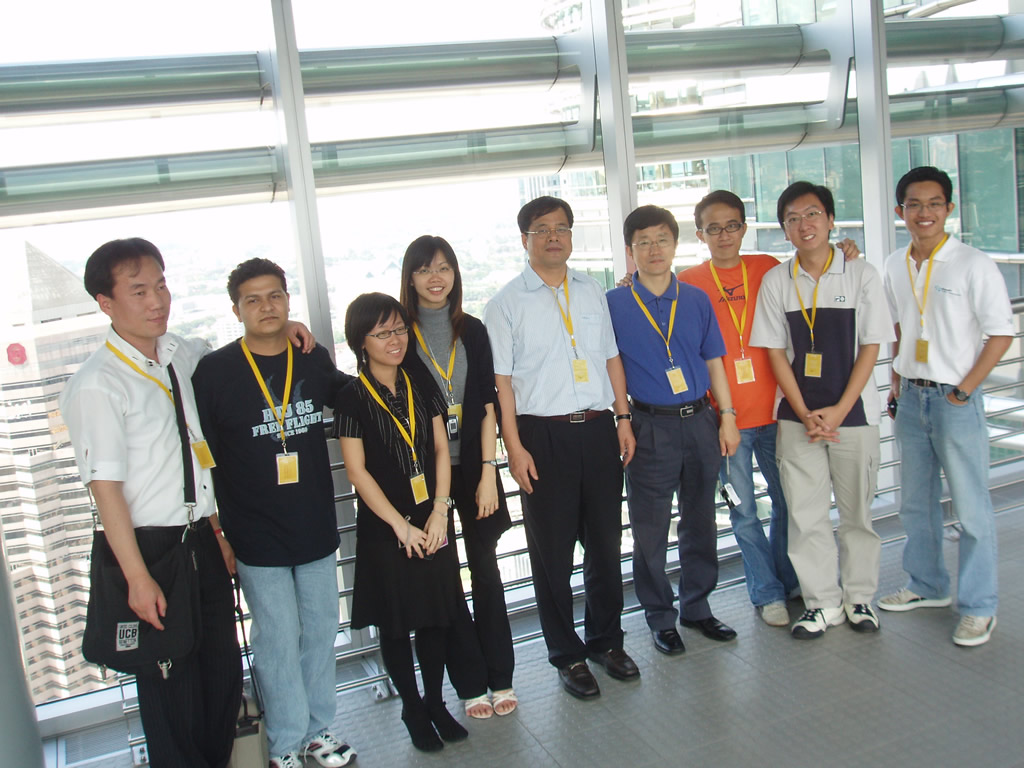
(L-R) Shin Kwang-Sig, Vinay Kumar Singh, Yang Chi Shian, Erin Lau, Prof. Chung Wan-Young, Prof. Lim Hyotaek, Ryan Yong Sau Heung, Me, Nelson

Visitors from Dongseo University, Busan, South Korea came to Kuala Lumpur for the 6th Asia Pacific International Symposium on Information Technology held in University of Malaya. They were here from 19-22 January 2007.

It was a rather eventful and "adventurous" tour, while they were here. More details may be supplied in future post. For now, enjoy the photograph taken on the Skybridge of Petronas Twin Towers at Level 41 on 21 January 2007 (Sunday). Special thanks to Nelson for getting up early for the tickets.

Wednesday, 17 January 2007

Peculiar Tea

Here's the text if you cannot see it from the picture.

고려인삼차
KOREAN GINSENG TEA

식약청제04-0118-011호건강기능식품

본 인삼차1~2포를 한잔의 온수 또는 냉수에 넣은 후 잘 저어서 음용하십시오.
봉밀 또는 감미료를 첨가하시면 인삼의 풍미를 더욱 즐길 수 있습니다.

DIRECTIONS
Put one pack or two packs of ginseng tea in a cup of cool or hot water, and drink it after beating.
Add honey or sweetner, and you can feel more peculiar taste of ginseng.

飮用法
本人蔘茶1~2包をコップー杯のお湯、または水た入れよく混ぜて飮んでください。
蜂蜜あるいは甘味料を添加すると人蔘の風味をもっと樂しめます。

飲用法
把人參茶1~2袋到入一杯溫水或凉水中,充分搖勻后飲用。加入一些蜂蜜或甛味劑,會使人參味道更加,口感更好。

I'm not very sure of the Japanese portion, but the rest of it, there are way too many mistakes!

With my limited Korean, I can roughly tell what does the Korean portion trying to convey. Keeping it close to the original, it means : After you have put 1-2 packet of the ginseng tea into a cup of warm or cool water, stir well before drinking. If you were to add honey or sweetener, you will enjoy better taste to it.

The English portion is the most hilarious of all. Why does anyone want to beat a tea? This is not an egg, right? Sweetner is not even a word, and I would definitely not want to drink a tea with peculiar taste!!

This is how I would put it : Put one or two packs of ginseng tea into a cup of cold or hot water, and stir well before drinking. Adding honey or sweetener into the tea can enhance the flavour of the ginseng tea.

The Chinese portion, sounds ok in general, but I guess they didn't bother to proofread it again. They use a mixture of simplified and traditional Chinese, and one word in particular, 甛, is one of those variant we hardly use. I guess no one will shake the tea (搖勻), especially not for ginseng tea.

My version of the Chinese portion would be
飲用法: 將1~2袋人參茶倒入一杯溫水或冷水中,充分攪勻后才飲用。加入一些蜂蜜或甜味劑,會使人參味道更佳,口感更好。
If it is in simplified Chinese:
饮用法: 将1~2袋人参茶倒入一杯温水或冷水中,充分搅匀后才饮用。加入一些蜂蜜或甜味剂,会使人参味道更佳,口感更好。

Monday, 4 December 2006

Cangjie Keyboard 仓颉键盘

Old & New Keyboard

Finally, I have bought a Taiwanese keyboard here in Kuala Lumpur. After learning how to type in Cangjie, I was so tempted to get one keyboard that has Cangjie layout, but it is rather rare to find one here in Klang Valley. It was rather surprise for me to be able to get one from PC Fair on last Saturday in KLCC. There are a few to choose from, namely choice of black or white, and key " hardness". Choice of colour does not vary the price, but the " hardness" does. Hard keyboard was selling at RM13, while softer keyboard at RM19.

To those of you who would like to get hold of such keyboard here in Klang Valley, the store that I bought it from is located at Kompleks Desa, Kepong, near to Kepong Sentral KTM Komuter station. I do not have the exact store name here with me right now, but as far as I remember, the receipt stated the store is located at Lower Ground floor.

As shown on the picture above, before I had a Taiwanese keyboard, I had only a regular US keyboard. If you can't get hold of a Taiwanese keyboard, or you love your current keyboard so much, the best option is to go for keyboard sticker, which is even more hard to come by here in Klang Valley. Buying one from the Internet really cost a fortune.

How does a keyboard sticker looks like? Here is a sample keyboard sticker on sale in Hong Kong for HK$12 per piece:
Sticker

I bought three of this from Hong Kong with the help of someone. (If you really want to know, it's a boyfriend of my sister's friend's friend.) After applying it to my regular US layout keyboard, this is how it looks like:
Keyboard with Sticker

I also included a close-up photograph of the Taiwanese layout keyboard for you to compare the difference.
Chinese Keyboard Upclose

What do those characters on the keyboard mean?
This is probably one of the first question I asked myself, when I first encountered such keyboard layout via an image from the Internet. So, I included the image on the left and labelled it accordingly. On the top left is regular English alphabet. Character on the top right is 注音符号, or the phonetic symbols for Chinese, mainly use in Taiwan. Character on the lower left is for Cangjie 仓颉 input method, while character on the lower right is for Dayi 大易 input method.

Depending on which input method you use, you refer to different corners for the corresponding keys. I'm so happy that I can buy one of the keyboard here. A couple of weeks ago, I have asked my friend who is going to travel to Taiwan soon to get me a Taiwanese layout keyboard. Now, looks like there is no such need.

Tuesday, 31 October 2006

Korean Numbers

Another quick reference for learners out there. Again, like most language, usage of these numbers might have exception in some case or another.

1하나6여섯11열하나60예순
27일곱20스물70일흔
38여덟30서른80여든
49아홉40마흔90아흔
5다섯1050 

For counting days:

1(초)하루6엿새11열하루
2이틀7이레15열닷새 (보름)
3사흘8여드레20스무날
4나흘9아흐레30그믐
5닷새10열흘 

Monday, 30 October 2006

반대말

It's final lesson for this level, which means there will be test, and of course, new payment of course fee for next level. For easy reference, I put in the following opposite word for everyone to have a look.

small 작다 ×크다 big
many 많다 ×적다 few
low 낮다 ×높다 high
bright 밝다 ×어둡다 dark
easy 쉽다 ×어렵다 difficult
same 같다 ×다르다 different
hot (weather) 덥다 ×춥다 cold (weather)
skinny 마르다 ×뚱뚱하다 fat
long 길다 ×짧다 short
thin 얇다 ×두껍다 thick
near 가깝다 ×멀다 far
fast 빠르다 ×느리다 slow
narrow 좁다 ×넓다 wide
quiet 조용하다 ×시끄럽다 noisy
heavy 무겁다 ×가볍다 light
dirty 더럽다 ×깨끗하다 clean
hot 뜨겁다 ×차갑다 cold

Monday, 8 May 2006

Great read!

Whether it's 새댁 요코짱의 한국살이 (ISBN : 8990787084), 158公分的陽子小姐 (ISBN : 9867291190) or ソウルで新婚生活 (ISBN : 4479761349), I'll bet it is a good read, which I took less than 2 days to complete it! Tagami Yoko (田上陽子) has created such a good book, and it's rather fun to read, even though the book is a bit expensive to buy in Malaysia. It costs me around RM41, where if I were to buy the Chinese version, RRP is NT$250 (around RM29). It is only slightly cheaper than Japanese version RRP, which is ¥1,365 (incl. tax) (around RM44). The original Korean version is only ₩8,500 (around RM33). I bought the Chinese version, although I got to know this book from my Korean teacher, in which she bought the original Korean version. My sister loves it as well.

It's a book about Yoko-chan (a Japanese lady who is married to a Korean), and her life in Korea. It tells you about the culture shock she has gone through, and in some instance, comparing it to those in Japan. Some stories are rather hilarious. After reading the book, I found that the things that she found it rather surprise can be seen here in Malaysia as well. It makes me wonder how similar is Korea to Malaysia, like the bus experience, the hidden danger and so on.

Lost in Translation

I took these pictures in October last year at the famous KLCC Park.

And of course, the Malay 'equivalent' found near by:

To me, if the Malay sign was to be translated into English, I would say it means "In Action". Does "In Action" tells you that work is being done or it is under review whether a work will be done? It sounds something like the expression "I'll look into it". Whether there is anything done by the speaker or the speaker will try to see what he can do about it, unless we clarify with the speaker, the expression might be interpreted differently by different listener.

No doubt that some semantic might lost when translating from one language to another, but they could just use "Kerja sedang dijalankan&quit; which is more common than "Dalam Tindakan". Think I should go and have a look on the progress so far in the park. I might not even notice what is being done as the work mentioned might be just schedule maintenance of the park, or it is just how it was like in October 2005.